SiNANO Co-Organised Three Webinars to Explore the Future of Semiconductor Technologies
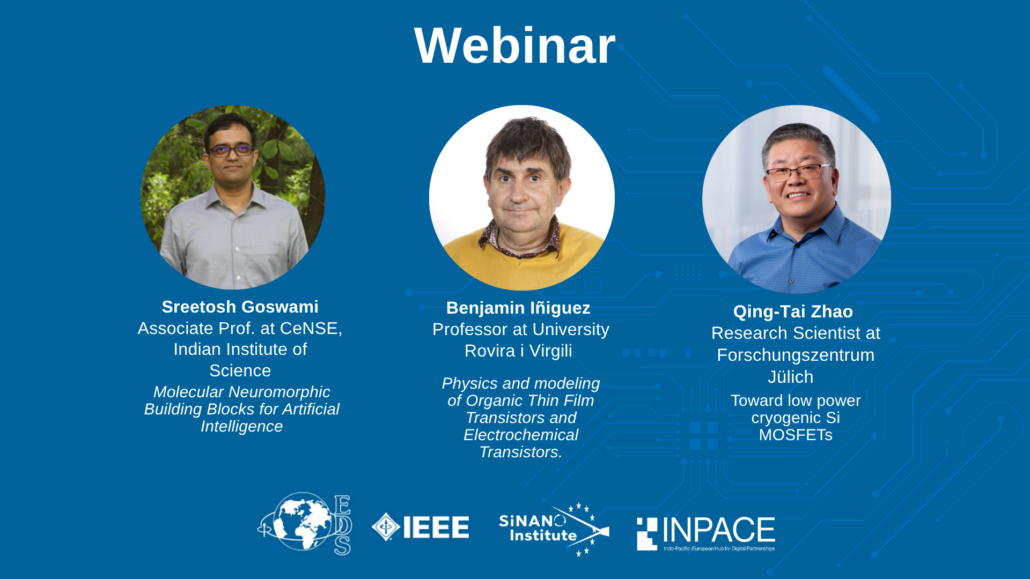
As part of the INPACE Cluster 4, “Enabling Technologies – Chips for the Future,” SiNANO co-organised three webinars in collaboration with INPACE, IEEE and the IEEE Electron Devices Society (EDS). Featuring leading experts in their respective fields, these webinars explored key developments in semiconductor technologies and advanced electronics, covering the three main thematic areas of the cluster: Advanced Computing, Advanced Functionalities and Ground-Breaking Technologies.
Through these sessions, participants had the opportunity to discover innovative research, gain insights into emerging technologies and explore solutions to some of the major challenges facing the future of computing and electronic devices.
1. Advanced Computing: Molecular Neuromorphic Building Blocks for Artificial Intelligence
Speaker: Sreetosh Goswami
This webinar explored the potential of molecular electronic devices to advance neuromorphic computing and artificial intelligence. As conventional computing architectures face growing challenges related to energy consumption and computational efficiency, molecular circuit elements offer promising new approaches to designing brain-inspired hardware.
Sreetosh Goswami, Associate Professor at the Centre for Nanoscience and Engineering (CeNSE), Indian Institute of Science, presented advances in molecular memristors and their potential applications in energy-efficient AI and machine learning systems.
The session highlighted how emerging molecular technologies could help overcome the limitations of conventional computing architectures and contribute to the next generation of intelligent hardware.
Discover the webinar and watch the replay
2. Ground-Breaking Technologies: Toward Low-Power Cryogenic Si MOSFETs
Speaker: Qing-Tai Zhao
This webinar focused on the challenges and opportunities associated with silicon-based transistors operating at cryogenic temperatures. As quantum computing and other advanced computing systems increasingly rely on low-temperature environments, developing energy-efficient electronic devices that perform reliably under these conditions has become a key research priority.
Qing-Tai Zhao, who leads a research group specialising in nanoelectronic devices at Forschungszentrum Jülich, presented the main physical and technological challenges of cryogenic CMOS, alongside promising device and material strategies to improve performance. The presentation also explored the feasibility of cryogenic memory based on a fully depleted silicon-on-insulator (FDSOI) MOSFET.
By addressing the integration of memory and logic functionalities within CMOS-compatible technologies, this webinar showcased innovative approaches to enabling more energy-efficient and scalable computing systems.
Discover the webinar and watch the replay
3. Advanced Functionalities: Physics and Modeling of Organic Thin Film Transistors and Electrochemical Transistors
Speaker: Benjamin Iñiguez
The third webinar addressed the physics and modelling of Organic Thin Film Transistors (OTFTs) and Organic Electrochemical Transistors (OECTs), which are promising components for flexible electronics, sensors and neuromorphic circuits.
Benjamin Iñiguez, Professor at Universitat Rovira i Virgili and an IEEE Electron Devices Society Distinguished Lecturer, presented the physical phenomena governing the behaviour of these devices and discussed techniques for developing accurate, physics-based compact models.
The presentation covered the modelling of drain current, capacitance, transient behaviour and noise, highlighting the importance of reliable device models for the design and optimisation of emerging electronic technologies.
By advancing the understanding and modelling of these transistor technologies, the webinar contributed to the development of new functionalities for next-generation electronic systems.
Discover the webinar and watch the replay

