Informations
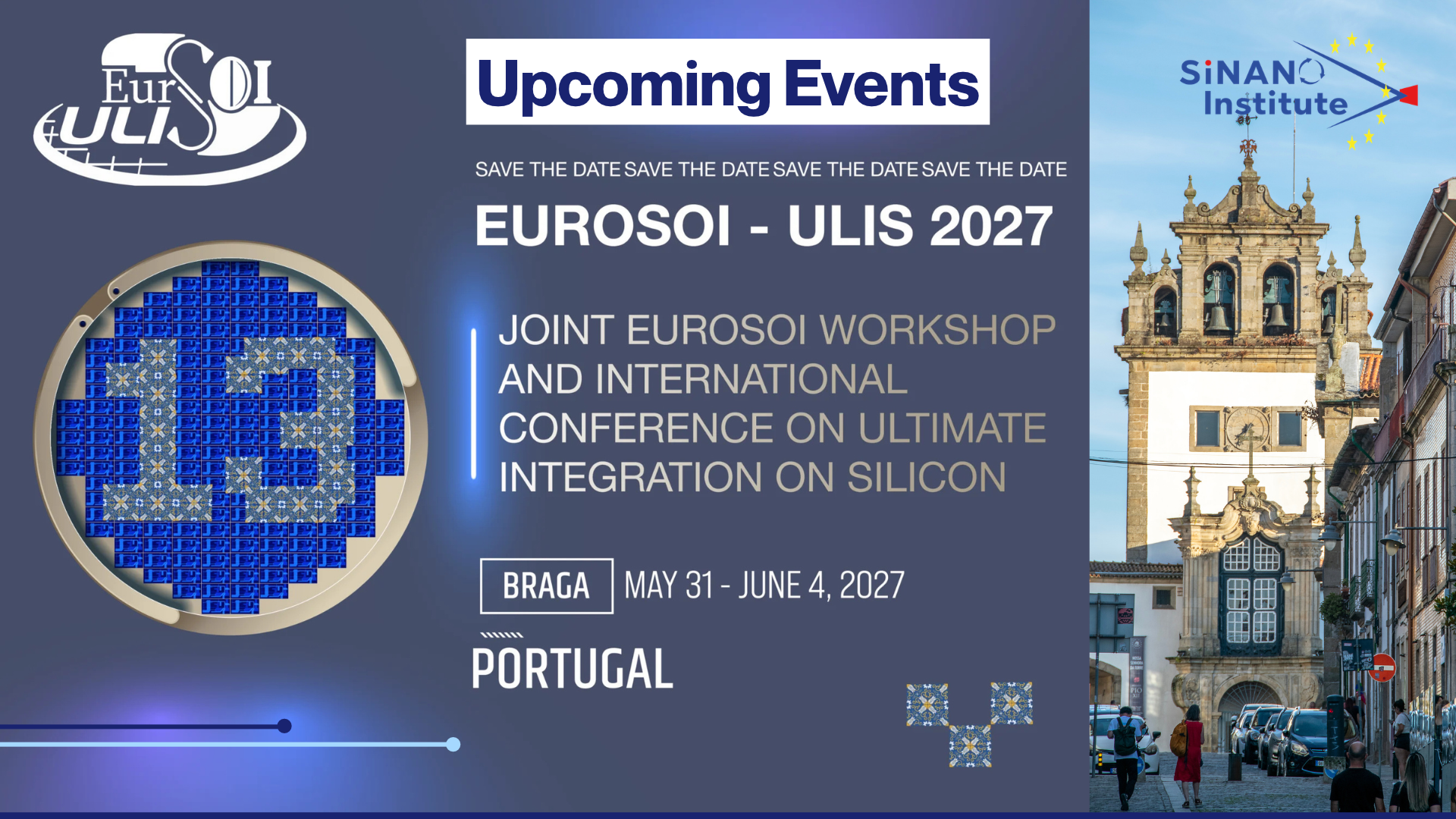
SiNANO Institute will take part in the 13th Joint EuroSOI Workshop and International Conference on Ultimate Integration on Silicon (EuroSOI-ULIS 2027). It will be held from 31 May to 4 June 2027 at the INL – International Iberian Nanotechnology Laboratory in Braga, Portugal.
EuroSOI-ULIS is an annual event that has been running since 2013. It brings together scientists and engineers in an interactive forum to discuss SOI technology and advanced microelectronic devices. A key objective is to foster collaboration and partnerships among academia, research institutions and industry stakeholders.
The conference welcomes contributions on a wide range of topics, including advanced SOI and emerging semiconductor materials, advanced transistor architectures and Beyond-CMOS devices, More-than-Moore devices, 3D and heterogeneous integration, modelling and simulation, emerging memory technologies, and neuromorphic and unconventional computing hardware.
Students and researchers from academia and industry are invited to submit their abstracts. The deadline for abstract submission is 15 February 2027.
Key dates:
- Satellite events: 31 May – 1 June 2027
- Main conference: 2 – 4 June 2027
SiNANO is among the sponsors of the event. The SiNANO Institute also awards the Androula Nassiopoulou Best Paper Award.
Find out more and submit your abstract: by following this link
Topics
- Advanced SOI and emerging semiconductor materials, including strained Si/Ge, III–V and oxide semiconductors, carbon nanotubes, graphene and other 2D materials, van der Waals heterostructures, ultra-thin films, buried oxides, defects, interfaces and advanced gate dielectrics.
- Advanced transistor architectures and Beyond-CMOS devices, including FD-SOI, FinFETs, nanowires, nanosheets, CFETs, MuGFETs, vertical MOSFETs, FeFETs, TFETs, 2D-semiconductor transistors, MEMS/NEMS and related concepts.
- More-than-Moore and functional devices, including nanoelectronics and biosensors, bioelectronics, RF devices, flexible electronics, imagers, integrated photonics, 2D optoelectronics, energy harvesting, quantum and cryogenic devices, nanofluidic and iontronic devices.
- 3D and heterogeneous integration, including monolithic and heterogeneous device integration, 2D materials on CMOS and photonic platforms, and emerging integration schemes.
- Transport, modelling and simulation, including electronic and ionic transport, compact modelling, atomistic and multiscale approaches, machine-learning-assisted modelling, device/process simulation and DTCO.
- CMOS scaling and device/circuit performance, including transistor, switch and memory scaling, performance benchmarking and device- and circuit-level evaluation.
- Advanced characterisation, reliability and variability, including test structures, operando and advanced characterisation techniques, interface/defect analysis, parameter extraction, reliability and variability of emerging materials and devices.
- Emerging memory technologies, including memristors and 2D-based memories, ferroelectric and other novel memory devices.
- Neuromorphic and unconventional computing hardware, including in-memory and in-sensor computing, neuromorphic systems, quantum computing architectures and other emerging computing paradigms.

