
Webinar – Molecular Neuromorphic Building Blocks for Artificial Intelligence
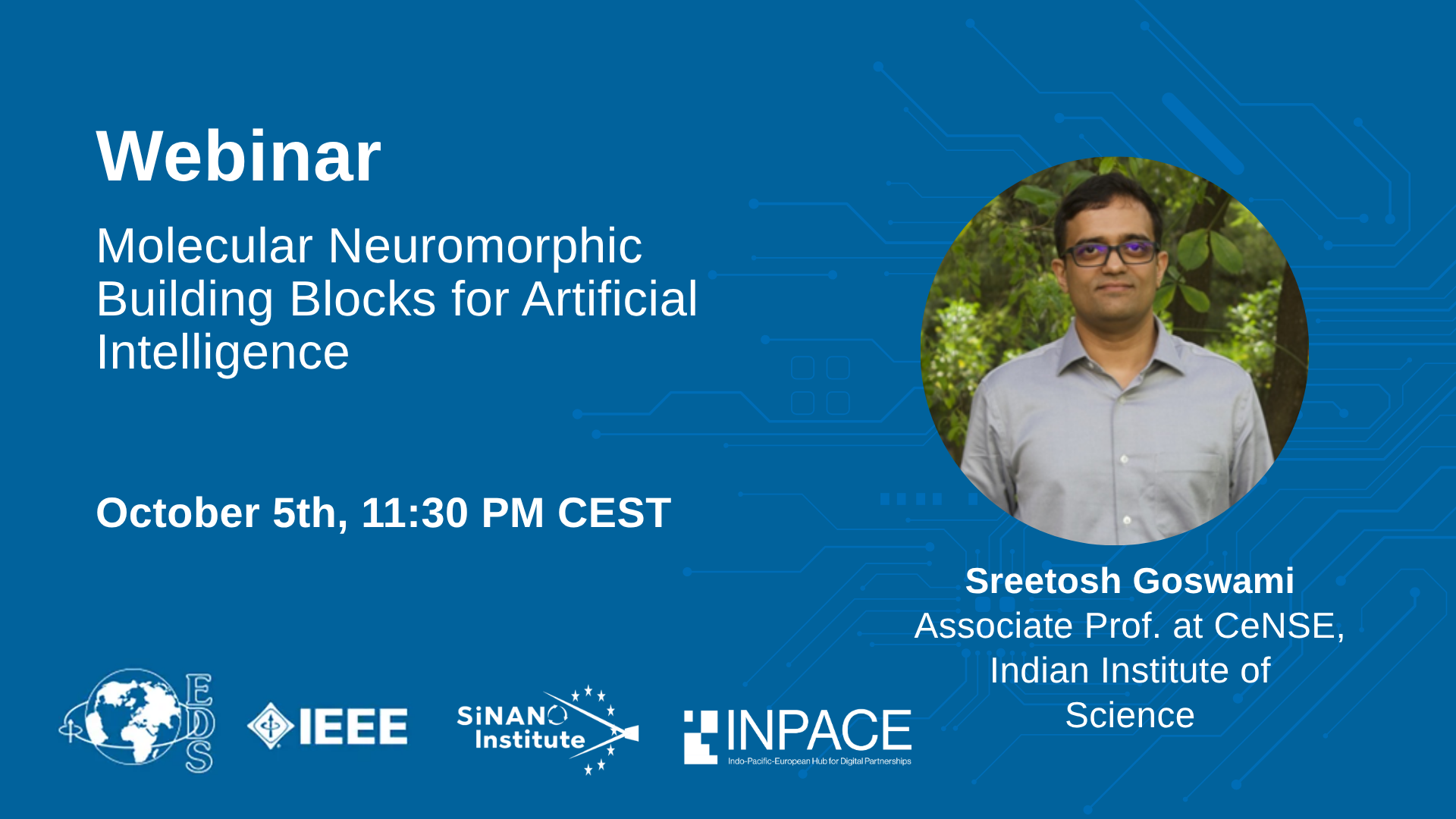
Join this online webinar on “Molecular Neuromorphic Building Blocks for Artificial Intelligence” by Sreetosh Goswami on October 5th.
Register here INPACE
Abstract:
Artificial Intelligence (AI) has long been a subject of fascination, oscillating between grand promises and inevitable disillusionment. While remarkable milestones, like AI outperforming human champions in complex games, suggest we are entering a new era of computing, a deeper look reveals that these breakthroughs come at a steep cost — demanding vast amounts of energy and intensive, expensive training process. In areas like cognition, decision-making, and intelligence, even our most advanced computing machines fall far short of the brain’s unparalleled efficiency and compact design. The core of this challenge lies in the limitations of conventional circuit elements and computing architectures, which struggle to replicate the brain’s complex, nonlinear dynamics operating at the edge of chaos. In this seminar, I will introduce a new class of molecular circuit elements designed to capture the intricate, reconfigurable logic that mimics brain-like behaviour at the nanoscale. These devices can be operated as analog or digital elements, or could be poised on the verge of instability, offering a unique potential to emulate neural functions in ways that traditional computing hardware cannot. Our journey explores these molecular systems from their foundational physics and chemistry, all the way to integrated circuit design and on-chip applications [1-9] with the aim of laying the groundwork for AI and machine learning platforms that can transcend the limitations of Moore’s Law and lead to a new era of energy-efficient computing.
References:
[1] Sharma, D., Rath, S.P., Kundu, B., Korkmaz, A., Thompson, D., Bhat, N., Goswami, S., Williams, R.S. and Goswami, S. Linear symmetric self-selecting 14-bit kinetic molecular memristors. Nature 633, 560–566 (2024).
[2] Sreebrata Goswami, Williams, R. Stanley, and Sreetosh Goswami. “Potential and challenges of computing with molecular materials.” Nature Materials (2024): 1-11.
[3] Pallavi Gaur, Bidyabhusan Kundu, Pradip Ghosh, Shayon Bhattacharya, Lohit T, Harivignesh S, Santi P. Rath, Damien Thompson, Sreebrata Goswami and Sreetosh Goswami, Molecularly Engineered Memristors for Reconfigurable Neuromorphic Computing. Advanced Materials (2025): e09143.
[4] Goswami, S. Reflections on the past decade of neuromorphic computing. Nature Reviews Materials 11, 431–432 (2026).
[5] S, H., Bhat, N. & Goswami, S. Neuromorphic pathways for transforming AI hardware. Nature Electronics 8, 752–756 (2025).
[6] P. Gaur, B. Kundu, P. Ghosh, et al. “Molecularly Engineered Memristors for Reconfigurable Neuromorphic Functionalities.” Advanced Materials 38, no. 23 (2026): e09143.
[7] Goswami, Sreetosh, et al. “Decision trees within a molecular memristor.” Nature 597.7874 (2021): 51-56.
[8] Goswami, Sreetosh, et al. “Robust resistive memory devices using solution-processable metal-coordinated azo aromatics.” Nature Materials 16.12 (2017): 1216-1224.
[9] Goswami, Sreetosh, et al. “Charge disproportionate molecular redox for discrete memristive and memcapacitive switching.” Nature Nanotechnology 15.5 (2020): 380-389.
Bio: Sreetosh Goswami is Associate Professor at the Centre for Nanoscience and Engineering (CeNSE), Indian Institute of Science. He joined IISc in 2021 after receiving his Ph.D. from the National University of Singapore. His graduate research was recognised with gold medals at MRS Spring (Phoenix, 2018) and E-MRS (Warsaw, 2018), and the Best Contribution Award at Memrisys (Dresden, 2018). His group develops energy-efficient molecular neuromorphic hardware for AI, with applications in deep learning, signal and image processing, and bioinformatics. The broader aim is to move computing beyond conventional CMOS limits and to provide tools useful to the wider scientific community.
His recent recognitions include the Advanced Materials Rising Star (2025), iCANX Young Scientist Award (2025), Wiley Young Investigator Award (2025), INSA Young Associate (2025), IISc Research Award (2025), Young Associate of the Indian Academy of Sciences (2024), the Young Physicist Award (2024), MRS-S Young Scientist Medal (2023), and the Pratiksha Trust Young Investigator Chair (2021).

